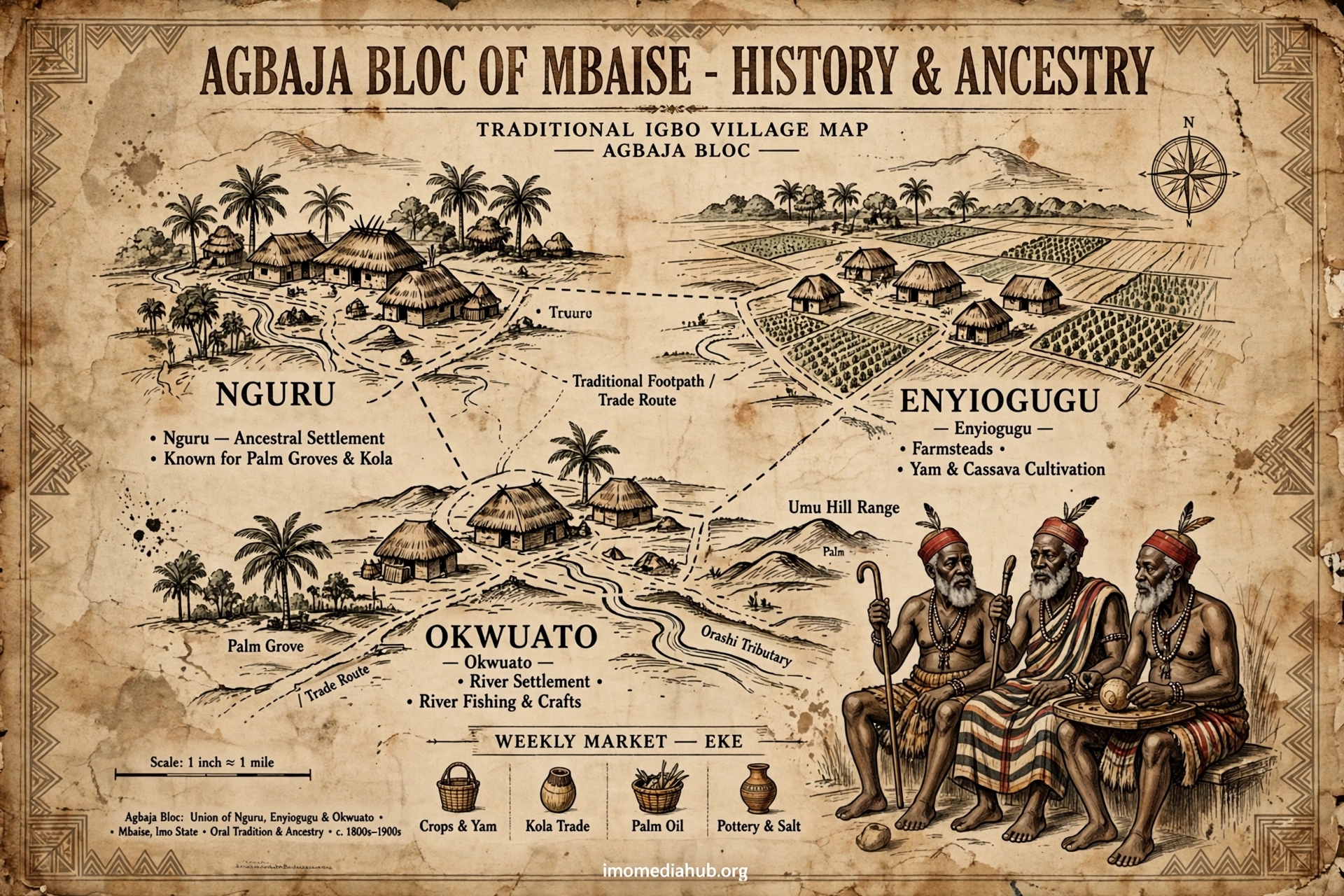
High Chief Nazzy Njoku explains the true origin of Agbaja bloc comprising Nguru, Enyiogugu and Okwuato, meaning of Agbaja, common ancestry, weekly markets, and how the name Mbaise was coined in 1941 by J. Iwunna of Amaohuru and headquartered at Aboh in 1948.
*Agbaja bloc of Mbaise*
The name Agbaja is derived because, throughout their land mass, there's no natural waters (like rivers, streams, lakes, springs, creeks, waterfalls, etc) passing the area so they live in land locked area - thus agba aja, in local parlance of yore.
Secondly, the people of Agbaja are knit by a common ancestry, against the narrative of some false accounts. Nguru and Enyiogugu are brothers. Enyiogugu's actual name is Akpuobi, a brother to Nguru. Akpuobi had a health challenge and on consultation with Ogwugwu god, he sacrificed self to the Ogwugwu god and that was how he lost his name as a sacrificial offering to the Ogwugwu and became subsequently addressed as Inyo (bounty) to Ogwugwu god. Later day dynamics considering that name as unsavory, blotted it and romanticized it to Enyiogugu. But within their kins sharing same socio-cultural affinity with them and beyond, the name of the community still sticks and pronounced inyogwogwu - being the right word, regardless.
Okwuato, the third community in the Agbaja bloc is a recent chosen nomenclature, indicating the three siblings comprising Lagwa, Ibeku and Umuhu. They are nephews to Nguru and Enyiogugu as they were fostered by their two uncles. Unlike the often wrong assertion, Umuhu that borders Ezinihitte are not Ezinihitte people. Due to long peaceful relationship and marriage with their immediate Ezinihitte neighbors, Umuhu became welcomed at Orji Ezinihitte cultural festival. But Umuhu is definitely and ancestrally indigenous to Okwuato community and Agbaja bloc, not Ezinihitte.
From the foregoing traditions of origin, the Agbaja clan rightly has same ancestry as can be observed by their scheduling and patronage of the major weekly markets in the bloc including Afonyogwugwu, Nkwolagwa, Ekenguru, Nkwogwu and Afoajala. These market days never clash against each other in the bloc, being same people. Ekenguru market sessions never clash with Ekeoha, so won't Nkwolagwa with Nkwogwu, Afonyogwugwu with Afoajala.
Until 1941, the name Mbaise never existed. What existed were their various autochthonous clan identities. Under British colonial rule, they were identified in colonial records as part of Owerri people (District), until 1941. Before then, each area was known by the community name though they inter related with closer communities and farther areas through trade, marriage, etc. The present Onyeaghalanwanneya bloc of Ngor Okpala ie Umuohiagu, Isu(Obiangwu) and Logara were earlier part of Agbaja by wrongful colonial arrangement. However by 1956, a referendum was conducted and they preferred and joined the Ngor bloc in present Ngor Okpala.
The choice of the name for the five clans of the area was made by an Nguru man by name J. Iwunna of Amaohuru. Some names were earlier considered including Mbaukwu, but his nomination was chosen. This was at a time the colonial government was desirous of federating clans into central administrations for convenience of governance, just as in the merger of Nigeria in 1914, to save cost of governance. Before then, the Nkwogwu colonial court founded in 1909 served as the center of administering many communities in the Agbaja bloc, including Logara, Umuohiagu, Obiangwu, parts of Amakohia in Ikeduru and Amuzi in Ahiara. With the establishment of court areas as somewhat colonial administrative units and with anthropological studies of the early 1930's identifying people of same genealogy and shared identity, need to unify them for same administrative status become exigent. The 1929 women's resistance to colonial oppression (ogu umunwanyi) had necessitated that careful investigation be made to identify the people's truer forms of rulership, shared commonalities, etc. For one, the Warrant Chief system was reviewed with village heads identified and used as headmen.
Preparations subsequently started to federate the five native/colonial court areas into a Native Authority, as in other colonial districts of Southern Nigeria. With the destruction in 1929 of the Nkwogwu native court that was established in 1909, by the women, a new colonial court was subsequently established at Enyiogugu where the colonial officers relocated. And from there the colonial officers sought a more central place to site the seat of the proposed Native Authority for the federated area in 1941-2 called Mbaise. To identify the headquarters, eye witness accounts reported that two men were detailed to trek from the two ends of the new Mbaise area - from Ogbor Uvuru in Oke Uvuru clan and Ogbor IhitteAforukwu in Ekwereazu clan. They eventually met at Aboh. The site was a virgin land and in a local parlance called abo. It was amplified in spelling by the colonial officers to Aboh. This seat that was accordingly located at the boundaries of Ezuhu Nguru and Oboama Ezinihitte took off effectively in 1948 when the colonial treasury at Enyiogugu new court premises was moved to Aboh, the new headquarters with administrative offices put up.
The above facts govern the Agbaja history. It should be noted that five components of Mbaise as a people do not have a common tradition of ancestry. Each of the five clans has its own different ancestral tradition of origin. It equally reflects in their cultural practices and even dialects. Agbaja has anthropological relationship with the Uratta (Owerri) subgroup. Their dialects are very close. Ekwereazu has commonalities with the Isu subgroup of the present Mbano. They both perform the cultural m iwa akwa manhood initiation and share strong dialectical parity. The Ezinihitte are of the Ngwa subgroup with tradition of origin and migration enroute across the Imo river but Ezinihitte settled on the fore side of the river while Ngwa people crossed over before the the tide rose. Their dialects are considerably close and their menu of achara soup and egusi cakes (mgbam) and other menu really exclusive.
However, one going factor for the Mbaise people is that sooner they were put together in 1942 from their various clans and cultural differences, they rallied together and immediately started forging new identities, sustaining shared ones and accepted their new fate as a people with common destiny devoid of acrimony. And this is what has sustained their present outlook as a hardworking, focused society, often attracting the envy of their neighbors and contemporaries.
_High Chief Nazzy Njoku_
BA History, MSc. International Affairs & System Studies
This article originally appeared on Imo Media Hub.
For More Original & Exclusive News Updates, articles, jobs, grants and other opportunities, Visit:
Website: https://imomediahub.org
Join Our WhatsApp Channel: https://whatsapp.com/channel/0029VbB1Oqb1t90iAOStYS0p